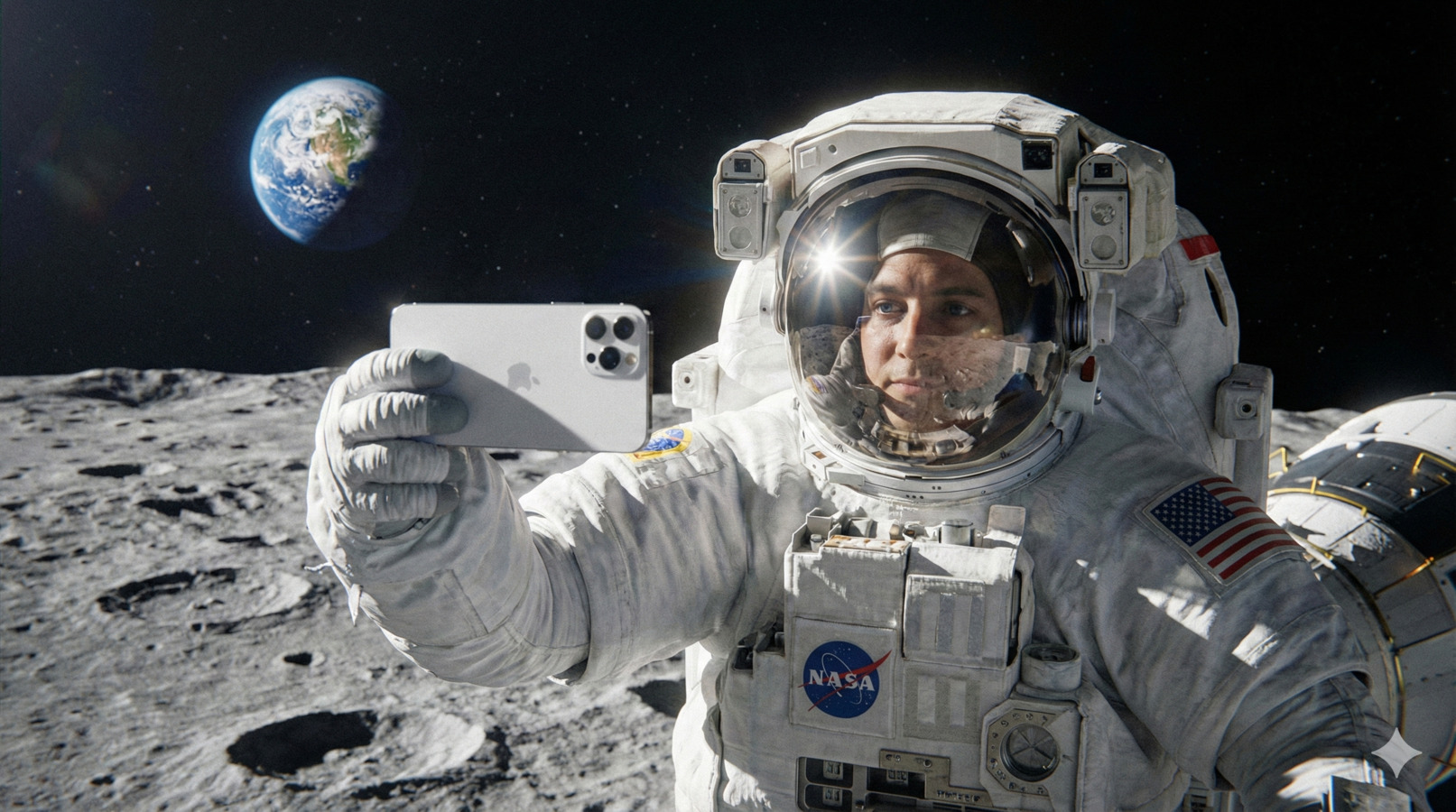
The NASA has officially authorized its astronauts to bring personal smartphones into orbit, a decision that marks a clear departure from the rigid procedures of the past.
This development will debut with two high-profile upcoming missions: Crew-12, whose launch to the International Space Station is scheduled for next week, and the highly anticipated Artemis II.
The latter, which will return humans to lunar orbit for the first time since the 1960s, has undergone a slight delay and is now scheduled for the month of March.
Ready to see the astronauts’ selfies from lunar orbit?

Until now, capturing images in space had been entrusted almost exclusively to robust but impractical institutional tools for the immediacy of social media, such as Nikon DSLR cameras or the GoPro action cameras, often technologically a decade behind the consumer market.
The introduction of the latest iPhone models and Android devices promises to radically transform the way we experience space missions from Earth.
The NASA Administrator Jared Isaacman has highlighted the importance of this openness through a post on the X platform, explaining that the intention is to provide crews the tools they need to capture special moments for their families and share images and videos capable of inspiring the world.
The ability to quickly pull a phone from the pocket will enable unprecedented spontaneity: we may soon witness social videos shot in zero gravity or ultra-wide selfies with Earth or the Moon in the background, making space exploration closer and more tangible for a global audience.
A leaner bureaucracy
Approval of consumer electronic devices for spaceflight is not a trivial process. Every single item on board must pass rigorous tests to ensure that it does not interfere with the spacecraft’s vital systems or pose a danger to the crew.
However, the speed with which this regulation change was approved signals an internal evolution within the space agency.
Isaacman highlighted how the agency has challenged long-standing processes to qualify modern hardware with accelerated timelines.
This “operational urgency“, as the administrator put it, will not only help take better photos, but will be valuable as NASA pursues high-value scientific and research objectives both in orbit and on the lunar surface.
Although this is not the first time a smartphone has reached space, SpaceX had already granted this freedom during its private missions; it is the first time NASA’s governmental astronauts have enjoyed such autonomy.
This step brings the human experience in space even closer to everyday life on Earth, promising to make future trips to the Moon the most documented and shared expeditions in history.